Export documentation is the foundation of a professional export operation. Missing or incorrect documents are one of the leading causes of shipment delays, port detentions, and buyer loss of confidence. This checklist covers everything Indian food exporters need to prepare — from company-level registrations to per-shipment documents.
Why Documentation Matters More Than Most Exporters Realise
A shipment with wrong or incomplete documents can be held at a port for days or weeks. A buyer who asks for your documentation and receives a slow, incomplete response loses confidence in your professionalism. And in international trade, once a buyer moves to a competitor, it's very hard to win them back.
Strong documentation signals three things to international buyers:
- You are a serious, experienced exporter — not a first-timer
- Your products are compliant with import regulations in their market
- Doing business with you will be smooth, not problematic
Part 1: Company-Level Export Registrations (One-Time Setup)
These are registrations you need as a food exporting company — done once and renewed periodically.
- FSSAI Export Licence: Mandatory for all food exporters. Separate from domestic FSSAI registration. Apply via FoSCoS portal.
- IEC (Import Export Code): Issued by DGFT. Required for all export-import activity. Apply at dgft.gov.in.
- APEDA Registration: Required for agricultural products (spices, cereals, processed foods, etc.). Register at APEDA.gov.in.
- RCMC (Registration-Cum-Membership Certificate): Issued by APEDA or relevant export promotion council. Required for some export incentives.
- GST Registration: Required for GST refund on zero-rated exports.
- AD Code Registration: Bank-issued code linked to your IEC. Required for all export shipments.
Part 2: Product-Level Certifications
These depend on your product category and target market.
| Certification | When Required |
|---|---|
| Halal Certificate | Mandatory for GCC markets; strongly preferred in UK, Southeast Asia for meat, dairy, processed products |
| Organic Certificate (NOP/EU) | If making organic claims for USA or European markets |
| Non-GMO Declaration | Required by many European buyers; best practice for US buyers |
| Phytosanitary Certificate | For plant-based products (spices, grains, pulses) — issued by APEDA or state agriculture department |
| FDA Facility Registration | Mandatory for all food exports to the USA — facility must be registered with US FDA |
| Certificate of Analysis (CoA) | Lab test report showing product meets specification. Required by most serious buyers. |
Part 3: Per-Shipment Documents
These are prepared fresh for each export shipment.
- Commercial Invoice: Issued by you to the buyer. Must show HS code, product description, quantity, unit price, total value, incoterms, and buyer/seller details.
- Packing List: Detailed breakdown of each carton — gross weight, net weight, dimensions, number of units per carton.
- Certificate of Origin: Issued by FIEO, APEDA, or Chamber of Commerce. Certifies the product was manufactured in India. Some markets require Form A (for GSP benefits).
- Bill of Lading (Sea) / Airway Bill (Air): Issued by the shipping line or airline. Proves the goods are being shipped.
- Health Certificate / Sanitary Certificate: Issued by FSSAI or state food authority. Certifies the product meets food safety standards.
- Fumigation Certificate: Required for wooden packaging or certain products. Issued by pest control company approved by NPPO.
- Insurance Certificate: Proof of cargo insurance. Required by most buyers under CIF terms.
- Prior Notice (USA only): Electronic notification to US FDA before every shipment. Must be submitted at least 4 hours (sea) or 2 hours (air) before arrival.
Maintain a separate documentation folder for each target market — UAE folder, USA folder, UK folder — with market-specific requirements. This makes your team faster and reduces errors when multiple shipments are running simultaneously.
Part 4: Label and Packaging Documentation
- Market-specific label artwork (Arabic for UAE, FDA-format for USA, etc.)
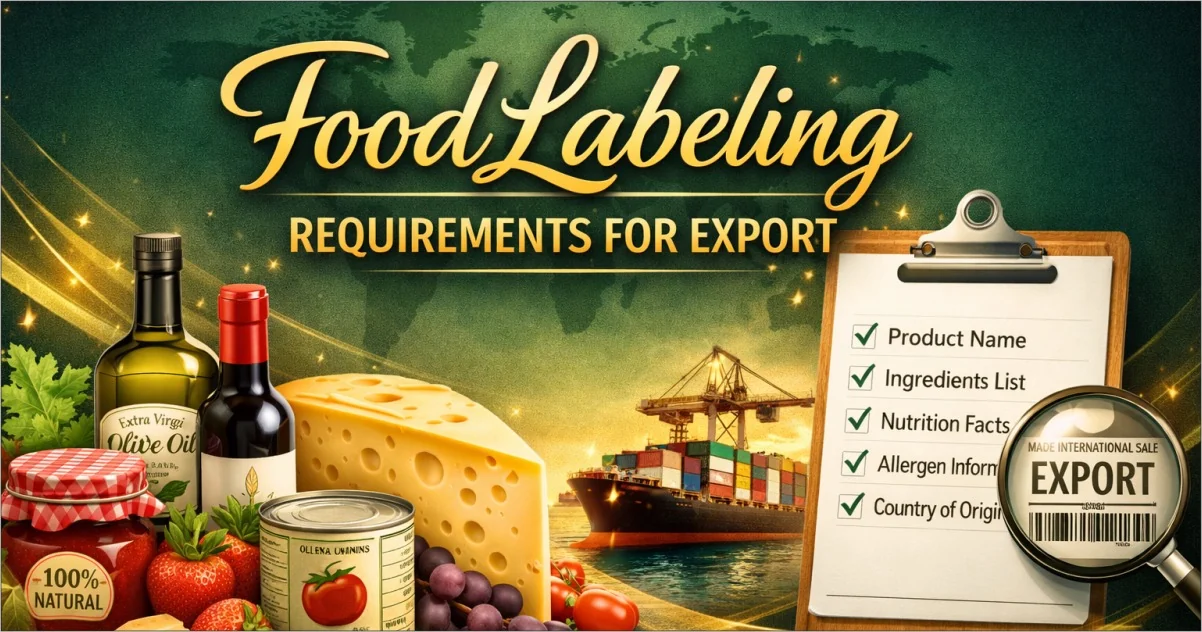
- Nutritional information panel in target market format
- Allergen declaration in target market language
- Shelf life confirmation with manufacturing and expiry dates
- Storage condition declaration
- Bar code registration (EAN/UPC for USA/Europe)
Part 5: Buyer-Facing Readiness Documents
These are not always legally required but are expected by professional buyers as part of their supplier qualification:
- Company Profile (2-page overview: who you are, manufacturing capacity, certifications)
- Product Catalogue (high-resolution images, product specs, shelf life, MOQ)
- Price List in USD/AED with clear incoterms
- Certificate of Analysis (CoA) for each product
- Sample Policy and Sample Dispatch Process
- References or testimonials from existing buyers if available
Many exporters get a positive response from a buyer, then scramble to get their documentation in order. By the time they send the documents, the buyer has moved on. Get all documentation ready before your outreach campaigns begin.
How Copago Supports Documentation Readiness
Copago's export documentation service helps Indian food brands organise, prepare, and review the complete documentation stack needed for international buyer conversations and shipments. Combined with compliance support for certifications and label review, it's one of the fastest ways to get professionally export-ready.
Conclusion
Documentation is not a back-office chore — it's a frontline sales tool. The exporters who have their documentation professionally organised close buyer conversations faster, face fewer shipment delays, and build stronger long-term relationships with international distributors. Use this checklist as your starting point, and work through each section before your next export campaign begins.
Ready to Find Global Buyers for Your Food Brand?
Talk to Copago's export specialists about buyer discovery, direct marketing campaigns, and compliance support — all in one place.